Guiding Light
The Woman Who Built It
The most striking thing about Guiding Light isn't how long it ran — though it ran longer than almost anything in broadcast history — it's that one woman wrote nearly all of it herself. Irna Phillips created the show and kept writing it while simultaneously plotting out up to half a dozen other serials at once, turning out roughly two million words a year. She didn't employ a writing staff the way Frank and Anne Hummert did with their stable of shows. She sat down with a secretary, acted out every character's voice herself, and dictated the whole thing. The scale of that output, sustained across nearly two decades of radio, is difficult to get your head around.
Phillips came to radio sideways. She'd been a teacher, and when she was around twenty-five years old she walked into Chicago's WGN as an actress. By 1932 she had moved into writing, and she spent the next several decades figuring out exactly what made serial drama work. Two things stuck: cliffhanger endings kept listeners coming back the next day, and slow, careful character development kept them coming back for years. Those two insights, held in tension with each other, are basically the grammar of the American soap opera, and Phillips worked them out in real time on this show.
She also made a deliberate choice about music. Phillips decided the organ was the right instrument for her serials — not played gently as background, but with what she called the pomp and power of a religious service in a great European cathedral. The show's theme was a thundering version of "Aphrodite," composed by Goetzel, played by organist Bernice Yanocek, who worked across several Phillips productions. In the early years the organ music was woven directly into the story, portrayed as Mary Ruthledge playing in her father's church. The sound was unmistakable and deliberate — this was not parlor music.
What Phillips built on Guiding Light became the template for a generation. She mentored Agnes Nixon, who would go on to create All My Children and One Life to Live; William J. Bell, who would create The Young and the Restless and The Bold and the Beautiful; and Ted Corday, who co-created Days of Our Lives. When Phillips transferred to her new show As the World Turns in 1958, Nixon took over as head writer of Guiding Light. The handoff did not end well — when Nixon eventually left, Phillips reportedly retaliated by having a beloved character, Meta's stepdaughter, crippled and killed in a traffic accident, which drew sharp viewer protest. Phillips died in Chicago on December 23, 1973, at seventy-two; Nixon learned of it when she called on Christmas Day to wish her former mentor well.
The World of Five Points
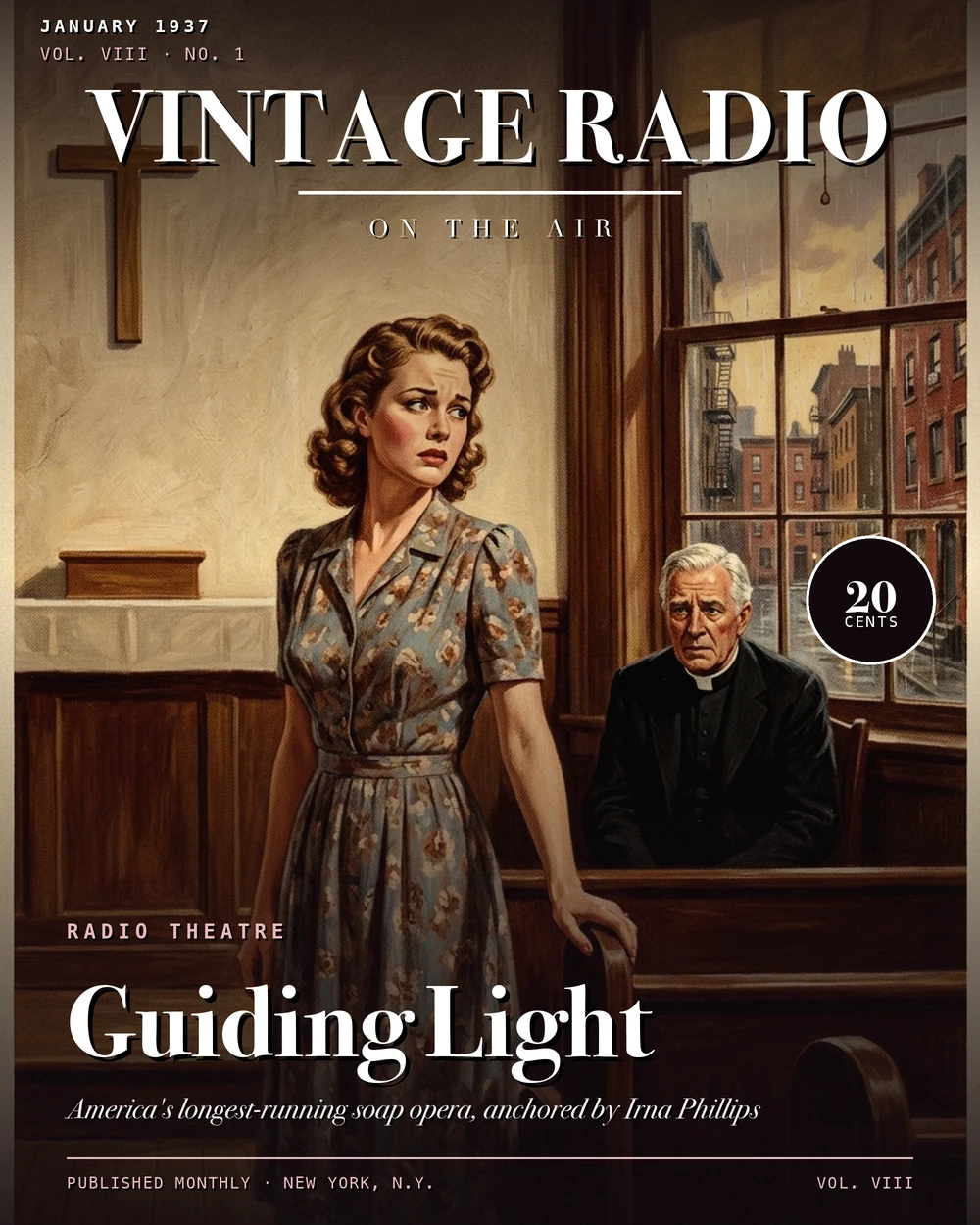
The show opened on NBC on January 25, 1937, with White Naphtha Soap as its sponsor, and it centered on Rev. John Ruthledge, played by Arthur Peterson, a minister who had come to a neighborhood called Five Points some twenty years before the serial began. Phillips described Five Points as a "melting pot of humanity" — Poles, Slavs, Swedes, Germans, Irish, and Jews packed together in uneasy proximity. One character described it as a place of "poverty, gossipy neighbors, sordid surroundings" with "no chance to get ahead." It wasn't a comfortable setting. Phillips wasn't reaching for comfort.
Ruthledge's congregation started as the Little Church of Five Points and became known as the Church of the Good Samaritan. Ruthledge himself was literally the guiding light the title promised — the moral center and the good Samaritan of the community. His daughter Mary was played first by Mercedes McCambridge, from 1937 to 1939, then by Vivian Fridell in 1942 and by Sarajane Wells across multiple stints. McCambridge was the one Orson Welles would later call "the world's greatest living radio actress," and her career after Guiding Light bore that out — an Academy Award for Best Supporting Actress for All the King's Men in 1949, a second nomination for George Stevens's Giant in 1956 opposite Taylor, Hudson, and Dean, and a credit she had to fight for as the dubbed voice of the demon Pazuzu in William Friedkin's The Exorcist in 1973, initially uncredited until a Screen Actors Guild appeal restored her name to a new print. She has two stars on the Hollywood Walk of Fame, one for film and one for television, and she died in La Jolla, California, on March 2, 2004.
Mary grew up without a mother, raised partly by Ellen the housekeeper, played by Henrietta Tedro. Then there was Ned Holden — played at various points by Ed Prentiss, Ned LeFevre, and John Hodiak — who had simply turned up one night at the Ruthledge house as a boy, about Mary's age, abandoned by his mother. He and Mary grew up together and fell in love, and they were set to marry when Ned discovered that his mother was a convicted murderess named Fredrika Lang, played by Margaret Fuller and later Muriel Bremner. Worse, he discovered that Ruthledge had known all along and said nothing. Ned disappeared. When he came back, he brought a wife with him — the actress Torchy Reynolds, played by Gladys Heen — and that was that for Mary.
Running alongside the Ruthledge story was the Kransky family: Abe Kransky, an orthodox Jewish pawnshop owner; his daughter Rose, played by Ruth Bailey and later Charlotte Manson; and Rose's brother Jacob, played by Seymour Young. Much of the early drama followed Rose's effort to climb out of Five Points. She had an affair with publishing magnate Charles Cunningham, played by Bill Bouchey, whose company would eventually publish Ned Holden's first novel when Ned tried his hand at writing. Rose eventually figured out that Cunningham was only cheating on his wife Celeste, played by Lesley Woods and later Carolyn McKay. In her grief she turned to Ellis Smith — Sam Wanamaker, later Phil Dakin and Raymond Edward Johnson — the young artist who'd arrived in Five Points calling himself "Nobody from Nowhere," which wasn't entirely a joke since Ellis Smith wasn't his real name either. He took Rose in to give her a name. The whole neighborhood was full of people carrying secrets they hadn't chosen.
In 1938, Phillips supervised a tie-in book — simply titled The Guiding Light, published by The Guiding Light Co. at 360 North Michigan Avenue in Chicago — that traced Ruthledge's backstory and rounded the world out with cast photos, transcripts of some of his sermons, and excerpts from Ned Holden's journal. It's the kind of merchandising gesture that suggests how thoroughly the show's listeners had moved into Five Points as a place.
Three Networks, Three Sponsors, One Writer
Phillips produced the show independently. She didn't sell time to a network and let them run it — she owned the production, paid her own casts, hired her own directors, kept two doctors and a lawyer on retainer as advisers, and sold the finished package to sponsors. After all those expenses, she was still clearing around $5,000 a week. The show ran on NBC under White Naphtha Soap's sponsorship through December 1941, then returned to NBC in March 1942 under General Mills, where it ran until late 1946. In June 1947 it moved to CBS, where Procter & Gamble's Duz Detergent sponsored the show through its radio finale on June 29, 1956.
In 1944, during the General Mills years, Phillips tried something nobody else had done at that scale: she assembled a full hour of consecutive programming on NBC from 2 to 3 p.m. daily, stacking three of her own shows back to back — Today's Children, The Woman in White, and Guiding Light. She'd already been the first serial writer to move characters between shows, and now she went further, having characters cross storylines freely across all three serials during the block. Ed Prentiss, who was playing Ned Holden on Guiding Light, served as a kind of master of ceremonies for the hour, stitching the three programs together. The fourth quarter-hour was filled with nondenominational religious music called Hymns of All Churches. During this period Phillips even considered abandoning the traditional fifteen-minute format and running story segments of ten to twenty minutes each — but after one season the block was dismantled and Guiding Light moved into its postwar phase on its own.
This wasn't Phillips's first experiment with crossover storytelling. Back in 1938 she had phased out her serial Today's Children by having its characters sit around a radio and listen to The Woman in White, which then replaced it. In 1939 she moved the Kransky characters out of Guiding Light entirely and into a new serial called The Right to Happiness.
How the Show Changed Hands Over the Years
Arthur Peterson's departure into military service in 1944 effectively ended the Ruthledge era. Phillips chose not to recast the Reverend — instead she wrote him into the Army as a chaplain. When Peterson returned to the show two years after his service ended, the story had moved on without him, and there was no going back to Five Points as it had been. The setting itself drifted west: production moved to Hollywood in 1947, and the story relocated to a fictional California town called Selby Flats, where it stayed until 1966, when it shifted one more time to the fictional Midwestern city of Springfield — the home it would keep for the entire rest of its television run.
The show passed through several different central figures over the following years. Dr. Richard Gaylord, played by John Barclay, became the strong male figure in the mid-1940s transition. By 1947 the center had shifted again to Dr. Charles Matthews, played by Hugh Studebaker, and a woman named Charlotte Wilson, described by Radio Life as someone "whose strange past is darkly troubled," played by Betty Lou Gerson. Her counterpart was Ray Brandon, played by Willard Waterman — a bitter ex-convict on parole who also went by Roger Barton.
By the early 1950s the show had found its final radio identity in the Bauer family: Bill Bauer, played by Lyle Sudrow; his wife Bertha, known as Bert, played by Charita Bauer; their young son Michael, played by Glenn Walken; Bill's sister Meta, played by Jone Allison; and the family patriarch Papa Bauer, played by Theo Goetz. James Lipton played Dr. Dick Grant, and Lynn Rogers played Marie Wallace. Charita Bauer would carry the role of Bert into the television version and play the character for three decades — one of the longer continuous character runs in American broadcast drama.
The End of the Radio Run
The show began simulcasting on July 20, 1952, airing on both radio and television simultaneously. The TV move was not Phillips's first attempt at the new medium — her These Are My Children had debuted on NBC in January 1949 as the first daytime soap opera on a major television network, and it had lasted exactly one month. That failure made what happened with Guiding Light on television all the more striking: the show settled in, kept growing, and ranked as the number one soap on the air in both 1956 and 1957 before As the World Turns took the top spot in 1958 and Phillips was transferred over to it. (In 2019, when Time created a series of covers honoring notable women of every year back to 1920, Phillips was chosen to represent 1957.) Over time the television version expanded into a daily hour-long program and the radio run became redundant. The final radio episode aired on June 29, 1956, closing out nearly twenty years of weekday broadcasting.
Surviving radio episodes are not as scarce as one might fear, but they're not common either. The Library of Congress NBC Radio Collection holds sixty-four episodes from 1942 to 1946, most of them from 1944, including continuous runs of twelve, sixteen, and eighteen episodes across June, July, and August of that year. Total survivals across all sources are estimated at fewer than two hundred, with roughly a hundred accessible through fan archives — heavily concentrated in 1950 episodes built around the Bauer family. One of those, episode 866 from September 22, 1950, dramatized Meta Bauer White killing her abusive husband Ted, whom she held responsible for the death of their son Chuckie; her temporary insanity was played as a real psychological break rather than a legal device.
There's also a piece of internal history that survived: when the show was preparing to move to New York and shift direction, an R-rated cast recording was made for Phillips's benefit, full of parody lines mocking the sponsor — one of them a crack about "new Duz with the hair-trigger formula." It's the kind of thing that surfaces when a long-running cast has been in the same room together long enough to feel comfortable getting irreverent.
Television Legacy
Guiding Light eventually accumulated a credential no other scripted broadcast has ever matched: the Guinness World Record for the longest-running scripted drama, across seventy-two combined years on radio and television, with episode counts variously cited at 18,262 and over 18,500. The television run alone accounted for more than 15,000 of those. CBS announced the cancellation on April 1, 2009 — April Fool's Day, which several fans initially refused to believe — and the series finale aired on September 18, 2009.
Across those decades the show kept doing the kind of thing Phillips had always done, which was to put difficult contemporary material into the daily lives of recognizable characters. In 1962, when Agnes Nixon was head writer, she gave Bert Bauer cervical cancer — one of the earliest social-issue medical storylines on American daytime television, and an arc credited with prompting a generation of female viewers to start asking their doctors about Pap smears. Four years later, in 1966, the show became one of the first network soaps to introduce regular African-American characters in professional roles when Dr. Jim Frazier and his wife Martha, a nurse, joined the cast, played originally by Billy Dee Williams and Cicely Tyson and later by James Earl Jones and Ruby Dee.
The show also moved with the technology of its medium: first broadcast in color on March 13, 1967; expanded from fifteen to thirty minutes on September 9, 1968 (and switched from live broadcast to pre-tape at the same time); expanded again to a full hour on November 7, 1977. Three decades after the radio run, the television serial was still anchored on the Bauer brothers and their careers in law and medicine — a family Phillips had set up in the show's final radio years and that kept paying dividends for half a century. Along the way the cast list became something of a feeder system for American screen acting: Kevin Bacon played the troubled teen T.J. Werner from 1980 to 1981; Christopher Walken and his brother Glenn alternated the role of young Michael Bauer starting in 1954; Calista Flockhart, Hayden Panettiere, and Taye Diggs all turned up at various points. For an awful lot of working actors, the show was where they learned to hit a mark on a tight daily schedule — the same discipline Phillips had imposed on her radio casts back in Chicago, carried forward on the same set of characters, for seventy-two years.